Archives
-
Thematic Diversity and Openness to Transdisciplinary Knowledge
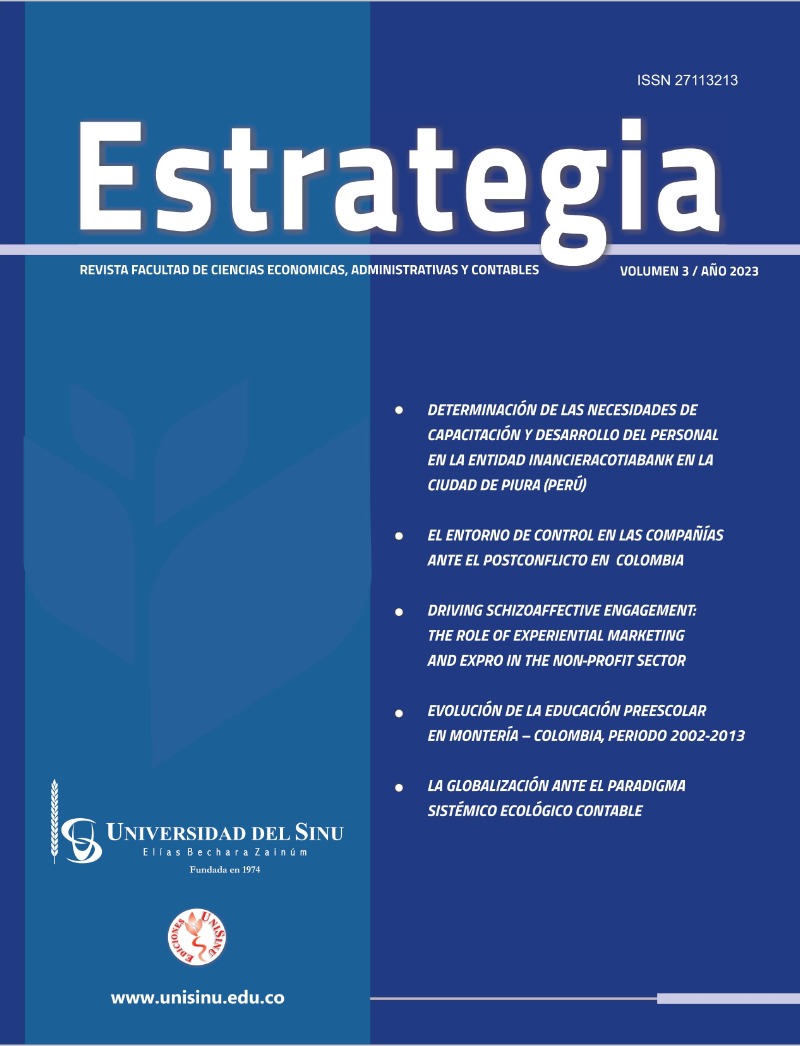
Vol. 3 No. 1 (2023)The dynamics of economic and administrative science today do not allow for isolation. On the contrary, they demand a perspective capable of integrating geographically distant realities, complex social challenges, and innovative methodologies. The 2023 edition of the journal ESTRATEGIA embodies this spirit of openness, establishing itself as a space where research transcends borders and disciplines to offer relevant solutions to the challenges of our time.
In this issue, the international dimension gains relevance through a study of training needs in Piura's financial sector, Peru. This work not only provides a comparative perspective on human talent management in the Andean region but also reinforces the idea that intellectual capital is the most critical asset in modern banking. Complementing this managerial vision, we delve into the national reality by analyzing the control environment in companies navigating Colombia's post-conflict period. This article is essential for understanding how organizations must adapt their governance systems in a context of social transition, where transparency and security become pillars of sustainability.
Pure theory also has its place. We revisit, in greater depth, the debate on wages, employment, demand, and production, analyzing the antagonistic approaches that continue to divide academia but remain essential for understanding current macroeconomic policy. Likewise, this edition dares to explore territories rarely addressed by traditional management through an innovative article on experiential marketing in the non-profit sector focused on mental health, demonstrating that market tools can and should serve social causes with profound human sensitivity.
Finally, we reaffirm our commitment to the territory. We present a detailed investigation into the evolution of preschool education in Montería (2002–2013). Understanding the foundation of our city’s educational system is key to understanding the basis of our future economic and social development.
From the Faculty of Economic, Administrative, and Accounting Sciences of Universidad del Sinú, we celebrate this edition, which is, in essence, a bridge between the global and the local, between rigorous theory and transformative practice.
-
Technological Vanguard and Humanism: The New Paradigm of Accounting Sciences
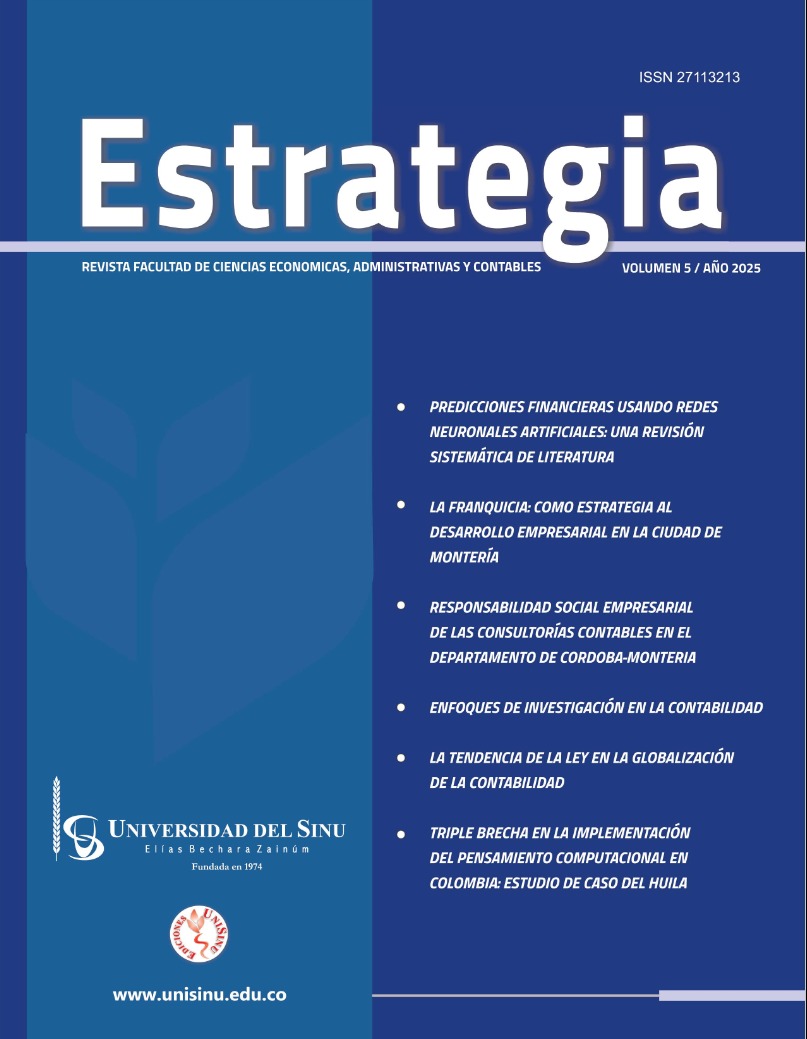
Vol. 5 No. 1 (2025)With the publication of this 2025 volume, the journal ESTRATEGIA not only concludes a successful editorial modernization process but also positions itself at the forefront of digital and social transformation. This edition is a faithful reflection of “Accounting and Administration 5.0,” where the efficiency of algorithms and the coldness of data meet the warmth of social responsibility and the depth of phenomenological thought.
The future has ceased to be a promise and has become a working tool. This is demonstrated by the systematic review on financial forecasting using Artificial Neural Networks, an article that leads this issue and highlights how artificial intelligence is redefining the analytical capacity of accounting professionals. This technical evolution is complemented by the analysis of the globalization of accounting and legal trends, reminding us that we operate within a dynamic regulatory environment that requires constant updating in line with international standards.
However, technological development lacks real impact if it does not translate into growth for our territory. For this reason, we highlight the study on franchising as a business development strategy in Montería, a research project that sheds light on how to stimulate the local economy through proven business models. Added to this is a critical analysis of corporate social responsibility in accounting consulting firms in the department of Córdoba, reminding us that regional advisors are key actors in building a solid and transparent business ethics framework.
Finally, this edition invites us to look back at the very essence of our discipline. Through articles exploring research approaches in accounting and a phenomenological analysis of labor social responsibility in accounting education (LSRAE), we reaffirm academia's role in training professionals who not only master technical knowledge but also understand its human and social impact.
From the Faculty of Economic, Administrative, and Accounting Sciences at Universidad del Sinú, we close this cycle of publications with the satisfaction of having accomplished a mission and our eyes set on the new challenges that science may bring. We invite our readers to immerse themselves in these pages, which ultimately serve as a map for navigating the complexities of the contemporary world.
-
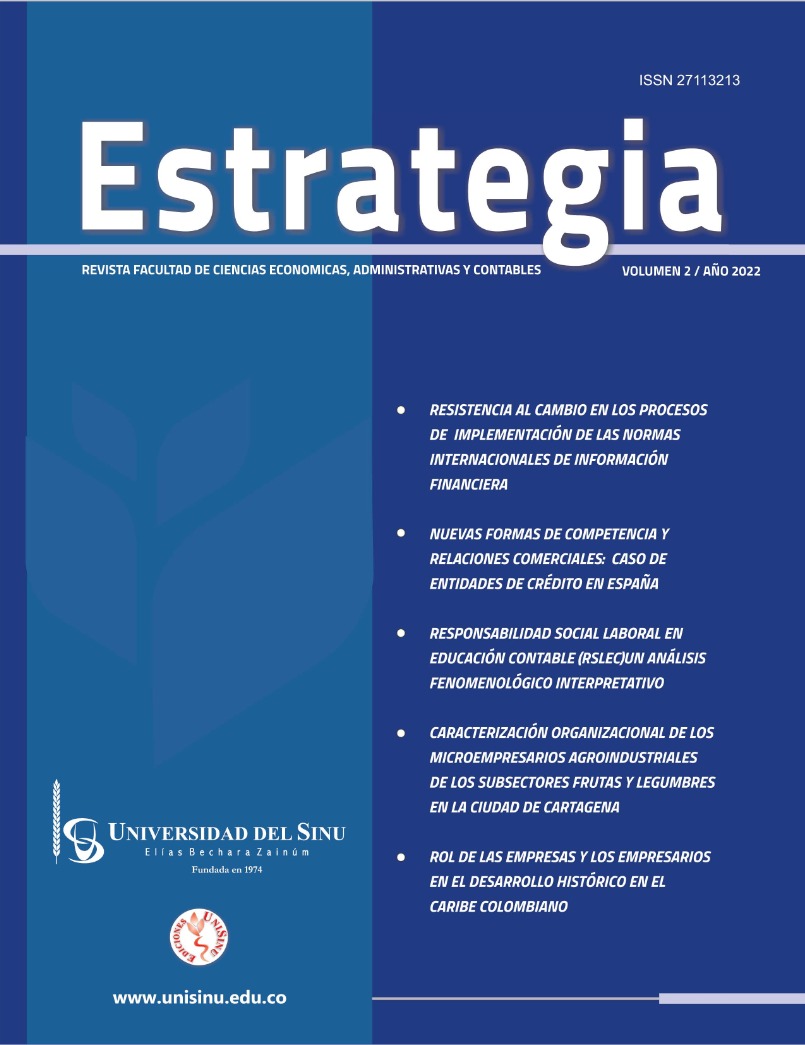
Between Global Standardization and Regional Identity
Vol. 2 No. 1 (2022)The year 2022 became established as the stage of the “new normal,” a period in which organizations not only had to resume their operations, but also assimilate the structural transformations accelerated by the pandemic. In this context, the journal ESTRATEGIA presents an edition that invites reflection on the duality faced by contemporary managers: the need to comply with highly demanding international standards while also maintaining sight of the particularities of the local business environment.
We open this issue with a critical analysis of resistance to change in the implementation of IFRS. This study reminds us that, beyond accounting frameworks and algorithms, organizations are made up of people; the success of any technical standard depends on the management of human and cultural factors. This global perspective expands through an examination of the European market, analyzing new forms of competition among credit institutions in Spain, a valuable mirror for understanding financial disintermediation trends that eventually impact our emerging markets.
However, the heart of this edition beats strongly in the Colombian Caribbean. The research on the characterization of agro-industrial microentrepreneurs in Cartagena highlights the resilience of the fruit and vegetable subsectors, pillars of food security and the popular economy. Added to this is the necessary continuation of the study on social responsibility in healthcare SMEs, a sector that, following the health crisis, has had to redefine its ethical commitment to the community.
Finally, we conclude with a note of identity and pride: the study on the role of companies and entrepreneurs in the historical development of the Colombian Caribbean. Understanding where we come from and how capital and industries were forged in our region is essential for projecting a future of strong business leadership and a sense of belonging.
From the Faculty of Economic, Administrative, and Accounting Sciences, we present this volume as a contribution to the dialogue between the global and the local, reaffirming our commitment to the dissemination of knowledge that positively transforms our environment.
-
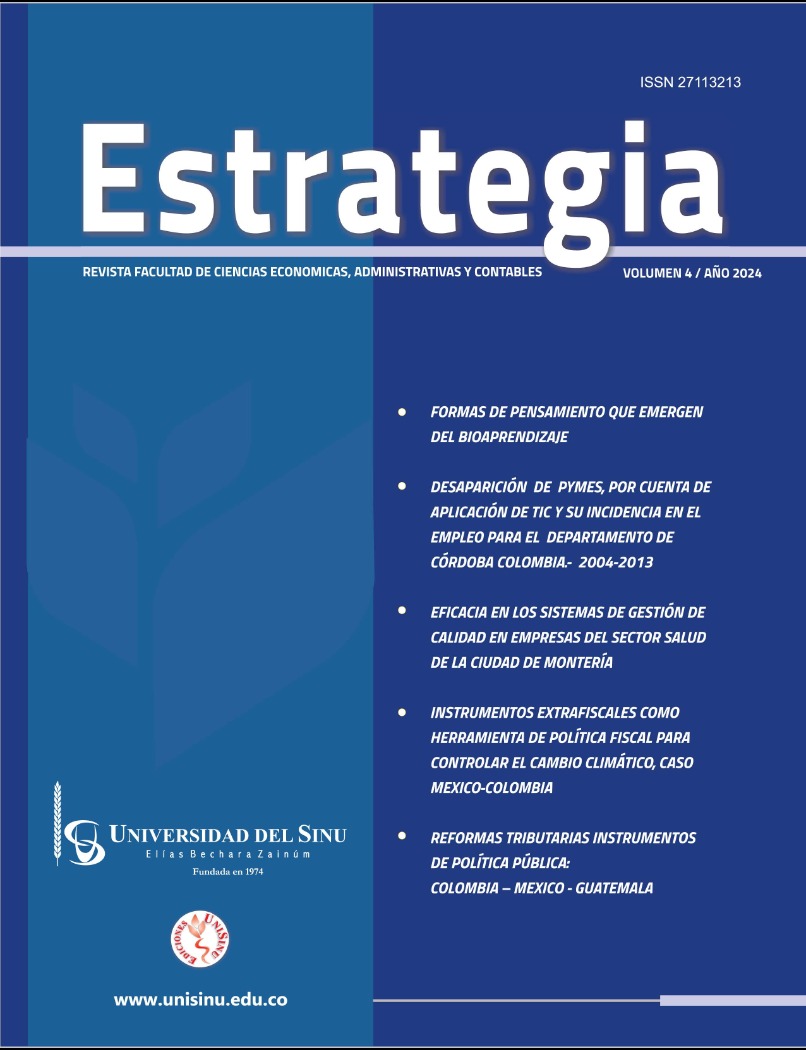
Horizons of Change: Between Innovation in Thought and Environmental Commitment
Vol. 4 No. 1 (2024)The year 2024 places us at a frontier of knowledge where traditional answers are no longer sufficient to resolve the crises of modernity. The journal ESTRATEGIA, faithful to its commitment to intellectual vanguardism from Universidad del Sinú, presents in this volume a series of studies that compel us to rethink not only organizational management but also the very way we learn and relate to our environment.
We begin with a disruptive proposal that explores forms of thinking emerging from biolearning. This approach invites us to understand that organizations and educational systems must emulate the resilience and interconnectedness of life itself, moving beyond mechanical models toward more organic and adaptable ones. However, this evolution is not free from friction; this becomes evident in the analysis of the disappearance of SMEs in the department of Córdoba due to the application of ICTs. Covering the decade from 2004 to 2013, this study is essential for understanding that digitalization, without strategic support, can generate employment gaps that still affect our region today.
Quality in service once again takes center stage, this time from a close-to-home perspective: the effectiveness of Quality Management Systems in Montería's healthcare sector. In a world where health is both a fundamental right and an administrative challenge, the findings presented here provide a roadmap for process optimization within our local institutions.
Finally, this edition extends its reach toward international public policy. Through a comparative study of Colombia, Mexico, and Guatemala, tax reforms are analyzed as instruments of social transformation. This analysis is further deepened by an innovative proposal for the use of extrafiscal instruments to combat climate change, a field where economic science meets environmental urgency to propose concrete solutions to the global climate crisis.
In light of this issue, the Faculty of Economic, Administrative, and Accounting Sciences reaffirms that research is the compass that enables us to navigate the tension between technological complexity and the need for sustainable human development.
-
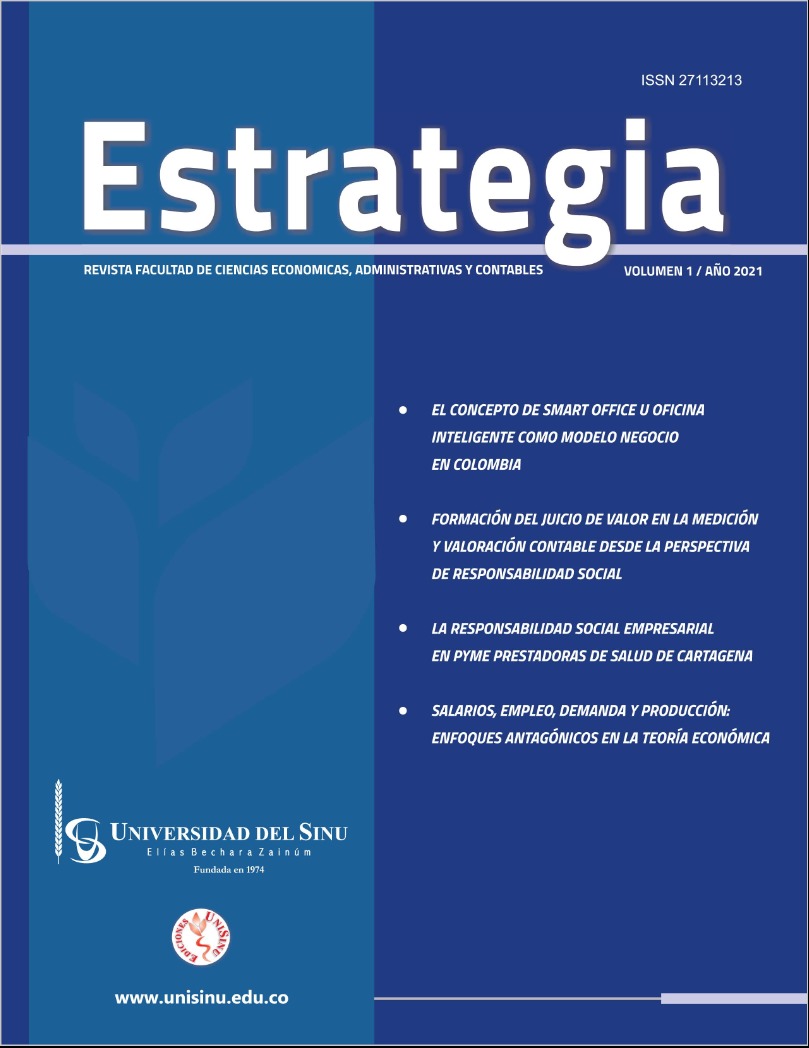
Resilience and Transformation in Post-Pandemic Economic Science
Vol. 1 No. 1 (2021)The edition the reader holds in their hands is not merely a compilation of scientific findings; it is a testament to academic perseverance in times of uncertainty. The year 2021 marked a period of critical transition for the world — and especially for academia in the Caribbean region. Following the initial impact of the global health crisis, the Faculty of Economic, Administrative, and Accounting Sciences at Universidad del Sinú took on the challenge of documenting the transformation of our organizations and theoretical models in the face of a reality that demanded immediate and rigorous responses.
In this issue, the journal ESTRATEGIA explores the convergence between technical innovation and ethical commitment. We begin with a look at the sophistication of decision-making tools in the article on financial analysis through fuzzy logic, a methodology that enables the uncertainty of the commercial sector to be addressed with a level of precision that traditional models sometimes fail to achieve. This pursuit of efficiency is complemented by the study on Smart Offices in Colombia, which reminds us that the workplace has ceased to be merely a physical location and has become a strategic digital ecosystem.
However, technique without ethics lacks purpose. For this reason, this edition places the human dimension at its core. It examines the formation of value judgment in accounting valuation in light of social responsibility, and grounds this concept in our regional reality through a study on corporate social responsibility in healthcare SMEs in Cartagena. These works emphasize that accounting and management are not ends in themselves, but tools aimed at social well-being.
Finally, we close with a necessary return to the fundamentals: an analysis of antagonistic approaches in economic theory regarding employment and production. At a time of economic recovery, questioning the major theories on wages and demand is essential for proposing fairer public policies.
We invite the academic community to rediscover these texts, which, although conceived amid the adversity of 2021, still provide valuable insights into the path we continue to follow toward research excellence.