Vol. 4 No. 1 (2024): Horizons of Change: Between Innovation in Thought and Environmental Commitment
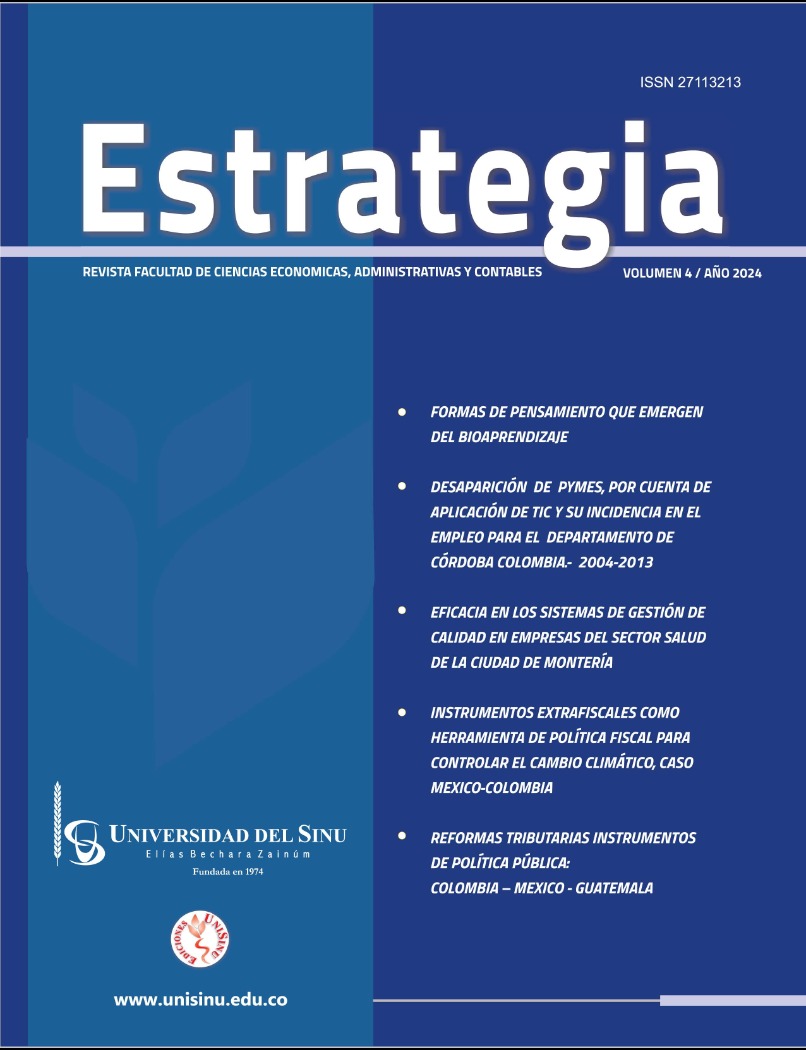
The year 2024 places us at a frontier of knowledge where traditional answers are no longer sufficient to resolve the crises of modernity. The journal ESTRATEGIA, faithful to its commitment to intellectual vanguardism from Universidad del Sinú, presents in this volume a series of studies that compel us to rethink not only organizational management but also the very way we learn and relate to our environment.
We begin with a disruptive proposal that explores forms of thinking emerging from biolearning. This approach invites us to understand that organizations and educational systems must emulate the resilience and interconnectedness of life itself, moving beyond mechanical models toward more organic and adaptable ones. However, this evolution is not free from friction; this becomes evident in the analysis of the disappearance of SMEs in the department of Córdoba due to the application of ICTs. Covering the decade from 2004 to 2013, this study is essential for understanding that digitalization, without strategic support, can generate employment gaps that still affect our region today.
Quality in service once again takes center stage, this time from a close-to-home perspective: the effectiveness of Quality Management Systems in Montería's healthcare sector. In a world where health is both a fundamental right and an administrative challenge, the findings presented here provide a roadmap for process optimization within our local institutions.
Finally, this edition extends its reach toward international public policy. Through a comparative study of Colombia, Mexico, and Guatemala, tax reforms are analyzed as instruments of social transformation. This analysis is further deepened by an innovative proposal for the use of extrafiscal instruments to combat climate change, a field where economic science meets environmental urgency to propose concrete solutions to the global climate crisis.
In light of this issue, the Faculty of Economic, Administrative, and Accounting Sciences reaffirms that research is the compass that enables us to navigate the tension between technological complexity and the need for sustainable human development.
Published:
2024-10-21